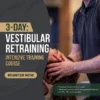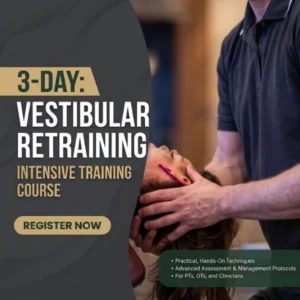
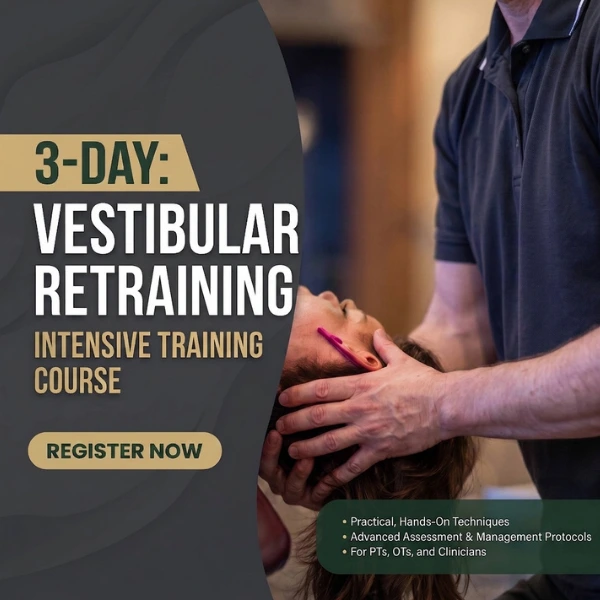
3-DAY: Vestibular Retraining Intensive Training Course
Original price was: $599.00.$49.99Current price is: $49.99.
Product details :
✔ Digital File Type(S): 2 PDF + 3 Video (17 H 34 M)
Dizziness, tinnitus, gait disturbances, sleeplessness, double vision… This vast range of symptoms makes vestibular rehab complex. And getting interventions wrong can severely delay your outcomes, leaving even the most seasoned clinician frustrated, intimidated, and apprehensive to take on new vestibular cases. But when patients show up at your clinic looking for answers, it’s disappointing to always need to refer them to other providers. That’s why we partnered with a leading expert in vestibular dysfunction, to bring you an intensive training with everything you need to know about managing this patient population. In this intensive training, powerful new techniques are shared that you can use – no matter your discipline – to navigate the essential elements of vestibular rehab. You’ll walk away with an adaptable, sure-fire approach to help these patients – without spending thousands of dollars on countless education courses. You’ll discover:
-
A step-by-step comprehensive assessment and screening process to lead you to the right clinical evaluation
-
How to identify red flags most clinicians miss and rule out competing symptoms
-
Actionable, easy-to-apply management strategies for the most complex hypo/hyperfunctions of vestibular dysfunction
-
Sign up today and unlock the skills you need to immediately transition your clinical interventions and stand by your decisions.
Speaker & Expert Background: Brings specialized services to many skilled nursing facilities and earned geriatric clinical specialist designation through the American Physical Therapy Association. Has experience in home health, acute care, outpatient vestibular rehab and fall prevention, acute rehab, sub-acute rehab, and long-term care. Additionally, serves as a clinical instructor to many doctoral physical therapy students. Graduated with a BS degree in PT from UNC Chapel Hill, and a DPT from Shenandoah University in March 2003.
Objectives:
-
Evaluate the latest advances in vestibular rehabilitation and their implications for rehab.
-
Analyze the anatomy and physiology of the vestibular system.
-
Examine signs and symptoms of vestibular dysfunction.
-
Demonstrate screens and tests commonly used to evaluate motion sensitivity in vestibular clients for improved outcomes.
-
Develop a comprehensive framework for evaluation.
-
Interpret evaluation findings appropriately.
-
Differentiate root causes of dizziness, vertigo, and vestibular disorders.
-
Determine appropriate candidates for vestibular rehabilitation.
-
Demonstrate maneuvers, rolls, thrusts, gaze stabilization exercises, and other vestibular rehabilitation techniques.
-
Explain clinical rationale for applying each technique.
-
Describe indications and contraindications for vestibular rehabilitation techniques.
-
Combine multiple approaches for better outcomes, including balance training, vestibular rehabilitation, gaze stabilization, targeted exercises and more.
-
Integrate therapy protocols for reducing dizziness, vertigo, and vestibular disorders.
-
Design comprehensive plans of care for a wide range of vestibular presentations.
-
Formulate strategies for addressing related symptoms, including headaches, neck pain, nausea and occasional worry.
-
Apply the assessments and interventions discussed in this seminar to a series of interactive case scenarios.
-
Justify practice with applicable progress measures.
-
Illustrate appropriate coding, billing, and documentation for vestibular disorders.
Outline: Hot Topics and Innovations in Management of Dizziness, Vertigo, and Vestibular Disorders
-
How your clients can benefit from cutting-edge research
HANDS-ON LAB: Upgrade Your Assessment and Clinical Reasoning Skills
-
Get to the root cause of functional challenges faster with today’s best tests and evaluations for:
-
Dizziness
-
Discomfort
-
Lightheadedness
-
Sleeplessness
-
Gait disturbances
-
Visual disturbances
-
Drop attacks
-
Double vision
-
Oscillopsia
-
Tinnitus
-
Motion sensitivity
-
Gaze stability
-
Balance
-
HANDS-ON LAB: Revolutionize Your Rehab Toolbox for Dizziness, Vertigo, And Vestibular Disorders
-
Practice effective techniques you can use immediately to:
-
Address years of vertigo and dizziness in as little as one session
-
Significantly improve functional mobility and stability
-
Manage minor concussion-related functional changes more effectively
-
Return athletes to activity faster
-
Prevent falls
-
Improve balance and gait
-
Restore gaze stability and focus
-
Reduce headaches, neck pain, nausea, tension, and other related symptoms
-
HANDS-ON LAB: Combine Techniques More Effectively for Better Outcomes
-
Practice integrating:
-
Epley maneuver and variations
-
Head thrust technique
-
Brandt-Daroff exercises
-
Roll technique
-
BBQ roll
-
Liberatory maneuver
-
Ocular motor assessment
-
Vestibular ocular reflex/gaze stabilization techniques
-
Saccade exercises
-
Optokinetic methods
-
Subjective visual vertical assessment
-
Progressive advancement of visual motion
-
Support for exertional tolerance
-
Smooth pursuit neck torsion test
-
Joint mobility for cervicogenic tension
-
HANDS-ON LAB: Design Advanced, Innovative Plans of Care for Your Clients
-
Practice developing comprehensive strategies for common functional challenges, including:
-
Cervicogenic tension
-
Concussion-related presentations
-
Benign paroxysmal positional vertigo (BPPV)
-
Vestibular hypofunction
-
Vestibular neuronitis
-
Vestibular migraine patterns
-
Labyrinthitis
-
Meniere’s presentation
-
Acoustic neuroma presentation
-
CASE STUDIES: Put Knowledge to Practice
-
Case study 1: Correctly identify the root cause of functional limitation
-
Case study 2: Differentiate cervicogenic tension, BPPV and vestibular hypofunction
-
Case study 3: Problem solve a complex case of vestibular hypofunction
-
Case study 4: Develop an effective management plan for Meniere’s presentation
-
Case study 5: Navigate pharmacological side effects and comorbidities
-
Case study 6: Accurately measure client outcomes
-
Case study 7: Overcome barriers to strategy implementation
Maximize Your Reimbursement
-
Coding and billing updates
-
Justify practice with the right progress measures
-
Avoid denials and audits with these tips
Target Audience:
-
Physical Therapists
-
Physical Therapist Assistants
-
Occupational Therapists
-
Occupational Therapy Assistants
-
Audiologists
-
Athletic Trainers
-
Physicians
-
Chiropractors
Related products
-
Manual Physical Therapy of the Spine
Original price was: $69.99.$19.99Current price is: $19.99. -
Principles and Practice of Chiropractic
Original price was: $69.99.$19.99Current price is: $19.99. -
Physical Therapy for Intervertebral Disk Disease: A Practical Guide to Diagnosis and Treatment
Original price was: $119.00.$19.00Current price is: $19.00.